 English


Views: 0 Author: Site Editor Publish Time: 2026-07-14 Origin: Site


Sourcing baby feeding products carries absolutely zero margin for error. A single flawed container compromises infant health severely. It risks harmful moisture contamination. It can also cause dangerous chemical leaching into infant food. These severe failures frequently trigger costly product recalls. Procurement buyers face a difficult dilemma today. You must distinguish between standard plastic manufacturers and specialized infant-product factories. True specialists deeply understand the rigorous compliance demands of modern parents. They also master the precise functional needs of formula feeding. This article delivers a definitive evaluation framework. Procurement teams, distributors, and retail brands will gain actionable insights. You will learn to properly assess material safety. You will understand essential functional design elements. We also outline how to verify supplier reliability before placing bulk orders.
Verification over Claims: Never accept generic "food-grade" claims; mandate verifiable, recent third-party lab reports (e.g., FDA, LFGB) specifically proving you are sourcing a BPA-free formula container.
Functional Non-Negotiables: Airtight sealing mechanisms and integrated leveling scrapers are baseline requirements, not premium upgrades, to meet parental hygiene standards.
Supplier Capabilities: A reliable baby formula box supplier must offer transparent Quality Control (QC) protocols, realistic MOQs, and cleanroom manufacturing environments.
Customization Readiness: Scalability depends on the supplier’s ability to execute a custom milk powder container through precise OEM/ODM molding and safe private labeling.
Modern parents are highly educated on CDC and FDA guidelines regarding formula storage. They read labels closely. They understand chemical risks. B2B sourcing must directly reflect this immense consumer scrutiny. You cannot rely on assumptions. You must demand verifiable proof of safety.
Manufacturers typically use various plastics. However, you should strictly require Food-Grade PP (Polypropylene) for the main body. PP resists high temperatures well. It remains stable during aggressive sterilization. You must pair this body plastic utilizing premium food-grade silicone for all seals. Standard rubber degrades quickly.
Suppliers often make bold safety claims. You need explicit documentation confirming the product is a true BPA-free formula container. Furthermore, tests must prove the absence of BPS and Phthalates. These endocrine disruptors severely harm infant development. Do not accept a simple "BPA-Free" sticker. Demand the underlying chemical analysis sheets.
Different global markets enforce distinct safety frameworks. You must check for region-specific certifications before importing. The US requires FDA compliance. Europe mandates strict LFGB standards. China relies on GB standards. Meeting one standard does not guarantee universal compliance.
Risk mitigation requires diligence. You should cross-reference all third-party testing reports. Look for documents from SGS, TUV, or Intertek. Compare the factory name on the report to your actual supplier. Many trading companies use borrowed certificates. This practice exposes your brand to massive liability.
Certification Standard | Region Focus | Key Testing Focus | Difficulty Level |
|---|---|---|---|
FDA (21 CFR) | United States | Raw material safety, heavy metals | Standard |
LFGB | Europe | Sensory testing, chemical migration under heat | Very High |
GB 4806 | China | Food contact materials, decolorization | High |
Best Practice: Always request lab tests dated within the last twelve months. Factories sometimes change raw material suppliers. Older reports might not reflect the current production batch.
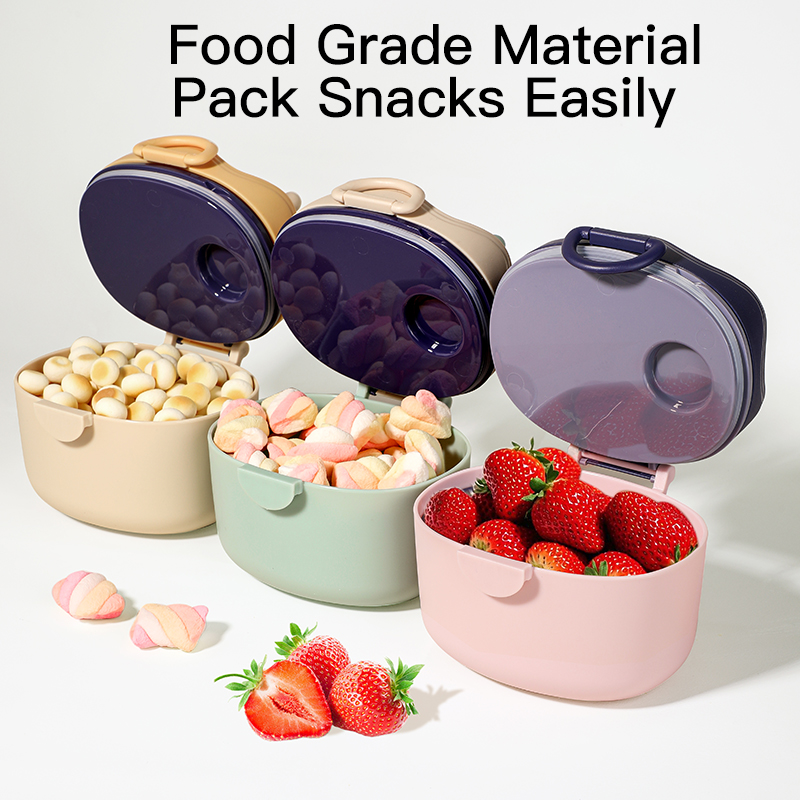
The moisture problem demands immediate attention. Baby formula powder clumps rapidly if exposed to humidity. Clumped powder spoils fast. It also prevents accurate measuring. Improper measurements disrupt infant nutrition directly. Therefore, you must source a highly reliable baby milk powder box offering absolute airtight protection.
Sealing mechanisms dictate shelf life. You must assess the thickness of the silicone sealing ring. Thin rings warp after washing. Assess how the factory integrates the ring into the lid. Removable rings allow thorough cleaning. Mold grows beneath permanently glued rings.
You also need to test mechanical locks. Snap-lock designs and twist-lock mechanisms behave differently over time. We recommend requiring factory stress-test data. The locking mechanism must endure over 1,000 opening cycles. It should not lose clamping force. Weak locks pop open during travel.
Parents prioritize hygiene above aesthetics. Your product must physically separate human hands from infant food. This requires specific structural features.
Separated compartments for the scoop: This layout prevents contaminated hands from touching the sensitive powder directly.
Built-in powder levelers: Integrated scrapers allow parents to measure exact scoops. Proper water-to-powder ratios prevent infant digestive issues.
UV-blocking tints: Clear plastics look clean but allow light penetration. UV-blocking tints prevent severe nutrient degradation during long-term storage.
Seamless interior corners: Rounded bottom edges prevent powder buildup. Square corners trap old milk powder easily.
Common Mistake: Overlooking lid hinges. Cheap plastic hinges snap after repeated boiling. Specify reinforced hinge pins during your procurement phase.
Buyers must match product designs to specific parental use cases. Evaluating a supplier's standard SKU catalog reveals their market understanding. A good factory offers varied capacities. They understand home use differs wildly from travel use.
Travel scenarios demand distinct engineering. You should evaluate stackable versus single-tier designs. Stackable units hold pre-measured portions perfectly. They save stressed parents valuable time during night feedings. You must also check for slim-profile shapes.
A well-designed portable formula storage box fits effortlessly into standard diaper bags. It should not create awkward bulges. It must withstand crushing forces. Parents often stuff these containers under heavy baby gear. Evaluate the structural ribbing inside the plastic walls.
Home storage focuses on volume and accessibility. Look for larger capacities ranging between 400g and 800g. These hold standard foil refill pouches easily. Bulk containers need one-button press-to-open lids. Parents often hold a crying baby using one arm. One-handed operation becomes a critical selling point.
Hygiene depends heavily on cleaning practicality. Are all parts fully detachable? Consumers will abandon products requiring specialized cleaning tools. The components must be fully dishwasher-safe. They must withstand high-temperature steam sterilization without warping. Good Polypropylene handles temperatures up to 110°C effortlessly. Ask your supplier for maximum thermal tolerance thresholds.
Retailers need a clear differentiation strategy. You must know how to elevate a generic product into a brand-specific asset. Customization builds intense customer loyalty. Therefore, your factory must possess strong engineering capabilities.
Evaluate the supplier’s capability to handle 3D prototyping. They must manage custom mold tooling internally. Outsourced tooling causes massive delays. A capable factory provides rapid prototyping services. Check their stated lead times for new molds. Industry standards dictate 30 to 45 days. Anything faster usually means skipped quality checks.
When developing a custom milk powder container, follow these precise steps:
Conceptual Design: Submit initial sketches. Ensure the factory engineers review them for injection-molding feasibility.
3D Printing: Request a physical SLA 3D print. Test the ergonomics manually.
Tooling Creation: Approve the steel mold cutting. Request material certificates for the mold itself.
T1 Sample Run: Evaluate the first injection samples. Check for flash, sink marks, or warping.
Visual branding matters immensely. Assess color-matching precision using Pantone codes. You must insist on food-safe dyes. Cheap colorants bleed chemicals into the formula. Discuss printing methods early. Silkscreen printing works for simple logos. Heat transfer printing offers better detail. In-mold labeling (IML) provides the most durable, scratch-resistant branding possible.
Finally, conduct a scalability check. Ensure the supplier contract retains your IP rights exclusively. They must demonstrate the capacity to scale custom designs. Sudden volume spikes should not cause exponential defect rates.
Finding a factory is easy. Finding a dependable partner requires rigorous auditing. The manufacturing environment directly impacts final product safety. You must look far beyond unit pricing.
Prioritize factories holding active ISO 9001 certifications. This proves they utilize formalized Quality Management systems. For infant products, cleanroom environments matter greatly. Look for a certified Class 100,000 dust-free workshop. This controlled environment prevents airborne contaminants from settling on plastic parts before assembly.
When you begin sourcing a wholesale baby milk powder box, analyze the commercial terms deeply. Compare Minimum Order Quantities (MOQs) against tiered pricing structures. High MOQs tie up your cash flow. However, extremely low MOQs might indicate a trader rather than a direct manufacturer.
Assess packaging efficiency closely. Can the boxes be nested? Can they stack efficiently inside master cartons? Clever nesting reduces volumetric shipping weight. It cuts expensive overseas freight costs dramatically. Ask the baby formula box supplier to provide a precise packing layout plan.
Watch out for dangerous implementation red flags. Avoid suppliers who outsource injection molding. Unverified third-party workshops rarely maintain cleanroom standards. Your liability increases exponentially. Demand transparent defect replacement policies in your contract. A reliable partner replaces defective units unconditionally. They do not blame the shipping company automatically.
Sourcing a reliable baby milk powder box requires looking past unit price alone. You must rigorously audit material safety. You must test sealing efficacy carefully. You must inspect supplier manufacturing environments thoroughly. True quality protects the infant and shields your brand from disastrous recalls.
Your next-step action is simple. Before committing to mass production, request a comprehensive sample pack. Subject these physical samples to extreme temperature sterilization. Conduct rigorous water-leakage tests. Perform standard drop tests onto hard surfaces. Finally, demand to see the raw material safety data sheets (MSDS) alongside those physical samples. Rigorous upfront testing guarantees long-term market success.
A: Industry averages typically range between 1,000 and 3,000 units for standard designs. If you require custom Pantone colors or brand-new injection molds, MOQs generally start at 5,000 units. Buyers must balance lower unit costs against their own inventory risk.
A: You should advise your procurement team to request complete SGS or TUV lab reports. These documents must be dated within the last 12 to 24 months. Ensure the specific product SKU tested matches the exact item you are ordering.
A: The timeline breaks down into two phases. Expect 30 to 45 days for custom mold creation and sample confirmation. Once you approve the T1 sample, factory mass production requires an additional 25 to 35 days.
A: High-quality PP (Polypropylene) withstands temperatures up to 110°C (230°F). This makes them perfectly safe for boiling water and UV cabinets. However, buyers must explicitly verify this thermal threshold with the manufacturer to prevent product warping.


